Showing posts with label Reproducing varieties yourself. Show all posts

Friday, November 10, 2023

Propagating roses with a root grow tool

Propagation through cuttings is a rather successful way to get more of the same variety. If you want to even improve the success rate you can achieve this by using special root grow balls. What are root grow balls? Well, they are just a plastic tool that will ensure your cuttings will take root. You can easily buy them online at Amazon and they are really cheap and can be used many times.

How to use them? 
Well, it's fairly simple: Choose a rose stem that has bloomed but make sure it's at least as thick as a pencil ✏. Now you take a spot that's at least 20 cm or 8 inch from the top. Just above a pair of leaves you remove the green bark for approx 3 cm or 1 inch. So all the way around the stem..
If you want you can dip that area with root growing powder using a dry cotton swab (the ones you use for cleaning your ears. Dip it in the root powder and apply it onto the area without bark, don't overdo it.
Now you remove the two pairs of leaves above and underneath your treated area. Take your tool and open it. Take your stem and place it in one side of the mold. The area without the bark has to be in the center of the mold. Now fill it up with really damp potting soil (when you press the potting soil the water has to come out). Make sure that the mold is really full. Now you take the other part of the mold which you've already filled up with damp soil and place or click it on the other part of the mold. Now your cutting is entirely surrounded by potting soil and roots will start to grow in the mold. You must wait at least 20 days before you open the mold, I would wait 4 to 5 weeks. If roots have formed you prune the cutting away from the mother plant and you plant it in a pot. 

Roses from cuttings: Wet kitchen paper method

Growing roses from cuttings isn't that difficult, it only takes more time to get a strong good plant. The biggest advantages? Getting much, much older than grafted roses, more bushy, more healthy shrubs and many roses, like the once flowering roses and the Teas, do better on own roots. So plenty of reasons to try it.

Taking cuttings can be done when roses are dormant or in July when the stems have flowered. In fact it can be done all year round as long as you don't take new, soft wood. It has to be ad least medium hard if you do it in summer. 

Take your sécateurs or clippers and rub the blades with some desinfectant and go to your rose. Always take wood at least as thick as a pencil. Prune right underneath an eye. You can take several cuttings from a long stem. They have to be approx 20 cm or 8 inches long. If done in summer you remove all leaves except the two at the top. Now take scissors ✂ and remove a part of each of those two leaves.

Dip the bottom of your cuttings in root powder and give it a little slap to remove all excess. 
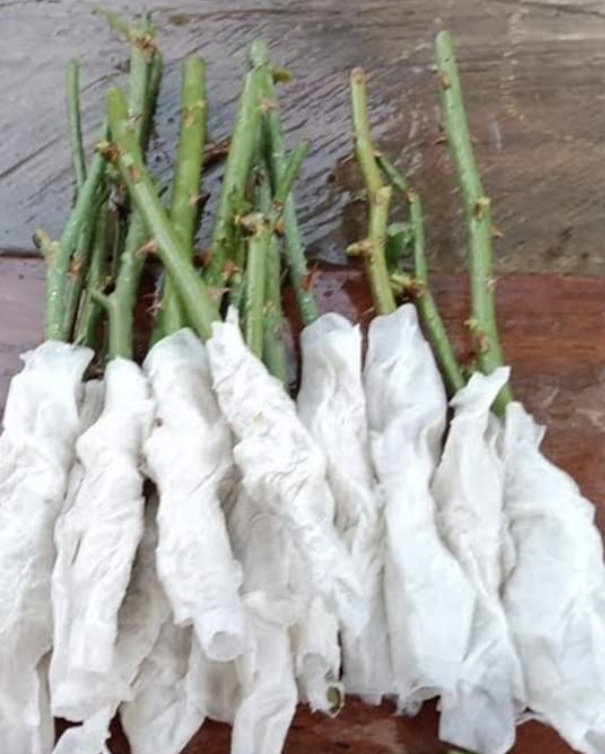
Now you take kitchen paper and you wrap it around the lower part of the cutting. When they are all wrapped in paper you spray them with a spray bottle filled with just water. They have to be really wet. Now you take a plastic zipper bag, the ones you can re-use for your sandwiches, those with a zipper. Put the cuttings in the bag and zip it up so no moisture can escape. Put the bag in a light spot but no direct sunlight. Room temperature or just a bit higher is perfect.
After three to four weeks you should see roots growing out of the kitchen paper. Maybe not all cuttings will succeed but that's okay, it doesn't cost you anything. 
When you see the roots clearly you open up the bag and you remove the paper gently. Put the cuttings in a glass of water immediately so don't let them dry out. 
Take plastic pots (higher is better than wide) and fill them for 1/3 with potting compost. Take your cuttings and put them in the pots. Hold them with one hand and fill up with your other hand. Gently press the soil around the cuttings and give plenty of water, it has to come out at the bottom. Make sure that at least 1/3 of the length of the cuttings is covered with soil.
Now you can keep them inside for a few weeks in a bright spot and after that they can go outside in a sheltered spot. No direct sun and no frost. If frost is predicted you bring them to a bright 🔆 frost free place. Don't let the pots dry out so make sure to check every few days. 
In spring they can go outside. Once you see that they start to grow you can bring them to partial shade first and after one week they can stay in full sun. Always check if they have enough moister but don't drown them. 
When you see that they are really taking off and roots are starting to come out at the bottom you can plant them directly in their final spot or you plant them in a bigger pot. 

Good luck! 

Thursday, November 9, 2023

Reproducing varieties yourself: Patents & considerations

Growing roses from cuttings is a fun and very satisfying way to create more of your beloved varieties.
Before we start I have to tell you that it's forbidden by law to grow roses from cuttings (or grafting for that matter) when the variety is still patented. This means that this variety can only be reproduced by the owner of the patent or nurseries that are allowed to do so. It's only normal that rose breeders want money for their creations. As long as the patent is in full force they get paid for each sold plant of their variety. Once when the patent is expired and didn't get renewed you're allowed to reproduce the variety yourself.
But! Rose breeders and rose nurseries aren't getting rich from their magnificent creations and it's essential we keep buying roses directly from the nurseries as this is the best guaranty for rose breeders to keep creating new roses. 
So which roses can we reproduce without feeling guilty or breaking the law? 

* Non patented roses which are nearly impossible to get in your country 

* You don't know the name of the variety of the old rose growing in your garden 

* Old heritage roses which are very hard to find, they aren't patented

* Old Modern roses without a patent that are very hard to find in your country

* When you have explicit permission from the patent holder when the patent is still in force 

A patent can be in force ranging from 15 to 25 years and it can get prolonged so it's always best to look it up on the internet HERE
Always search under the international variety name. For example the rose Jean de la Fontaine from Meilland has the international name of MEIffable 

Of course no police officer will come to your home when you propagate a valid patented variety but it's about doing what's right. If you can buy the patented variety in a nursery from your country just do the right thing and buy it there.