Monday, March 13, 2023

Awakening

Awakening, Jan BΓΆhm 1934
Probuzoni 

Modern Climber 

Quartered sport of New Dawn 

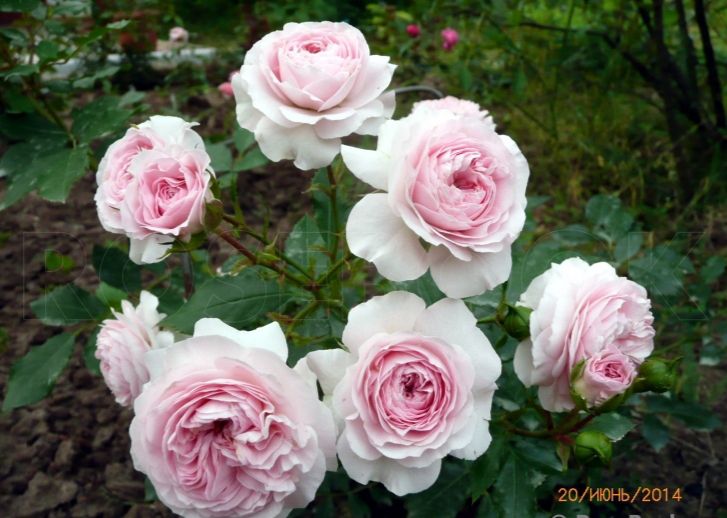
Discovered in 1934 in Czechoslovakia. Due to the Iron curtain and the Communist regime it was only in 1988  that it came to Europe and to Peter Beales. When it came on the market it created quite a stir. A quartered version of New Dawn was clearly sought after because New Dawn was at that moment the most popular climber in the world.
When Lens introduced it in Flanders I immediately bought the rose. She's still at my parents house today. The blooms are indeed mother of pearl pink, just like New Dawn, but they are very double, quartered. While New Dawn can support it clusters of flowers Awakening can struggle. Her flowers are bigger and heavier and when in clusters the flowering branches can bend down a bit. Although she can reach 400 cm or 12 feet I would use Awakening as an Obelisk, pyramid or Fence rose. Her blooms are very showy and beautiful so if you grow her this way you can admire the flowers better. Very hardy, zone 5b and warmer. Full sun is recommended if you want a good reblooming. Many also say that New Dawn is shade tolerant but that's not true. She really will struggle.
The fragrance of Awakening is a bit stronger than The New Dawn flowers cause she has more petals, it's a light apple fragrance like so many Wichuraiana hybrids. 
Awakening or New Dawn? Awakening for sure! 

Friday, March 10, 2023

Growing roses organically: Avoid using chemicals at all costs

Roses are very attractive to aphids as their juicy new shoots provide easy food for these insects. Aphids also multiply at a lightning speed so within a few days your new shoots can be covered by them. Since the Fifties of the past century people have been indoctrinated by the chemical companies to kill everything which may cause a thread to our garden plants. Aphids, caterpillars, Spidermites, beetles, sawflies etc but also fungal diseases. Weeds? Kill them with poison ☠. We were even brainwashed into thinking that you could use herbicides in your plant borders, underneath roses etc.. It was harmless to the soil and our plants as the products only affected the unwanted weeds... so it said on the label
After decades of uncontrolled use of pesticides, fungicides and herbicides we see the truly devastating effects of these products on our environment. Butterflies have been decimated since the late eighties, our pollinators are in dangerous decline and the biodiversity is dangerously low. A major effort is needed to restore our environment, to reach that balance again. We need to eradicate the idea that everything can be solved with chemicals as we are standing upon the ruins they caused.
We need to learn, to understand that we must cooperate with nature to get a well balanced ecosystem in our gardens, in our environment. Today that balance is gone in so many gardens but with a little bit of effort it can be restored 100%.
We as rose lovers should give the good example as many people think that roses can only be grown successfully with lots of chemicals. In reality the opposite is true: In a healthy garden, with a balanced ecosystem, roses are the most resistant and care free plants. But we need to understand some essentials:
All plants and trees in our gardens are standing outside, in nature, exposed to the elements so it's 100% normal to have roses with some defects. Leafs get bruised, get eaten, can get some spots from being outside... That's NORMAL. So don't go panicking if you see foliage which isn't 1000% pristine.
Our roses and we ourselves share the outside with countless of little critters, insects, birds, mamals etc and we NEED most of them to achieve that balanced ecosystem. Stop seeing insects and other living things as enemies because they are not. They all have an essential role to play in the ecosystem so yes, aphids, caterpillars, beetles... they all have a useful purpose. 
Does this mean we shouldn't intervene when we have a real infestation of aphids, sawflies, caterpillars, Spidermites or even worse.. Japanese beetles? No it does not but it means we should not intervene unless it's really really necessary and only with biological products harmless to pollinators and other animals. In 90% of the cases we don't need to take measures if we just have a little bit patience. Aphids can be removed with our fingers, with the water hose and by 🐞 and their larvae. For aphids you shouldn't use chemicals... EVER! Not even Neem oil.
When do we use Neem oil? When we have a very severe case of powdery mildew or blackspot and we always have to remember only to apply neem spray when sun is down in the evening. Spidermites can be treated by making the foliage wet for a few days per week. Spidermites on roses mean they are too dry and there's no good air circulation. Only when they don't go away after you've tried the water method you can use Neem but not earlier.
Caterpillar will get eaten by birds, by European hornets etc.. and we can inspect our roses ourselves and remove them when we see damaged leafs. Caterpillars don't die from Neem so it's useless to use it. Remove them yourselve or let nature do its thing. 
Strengthen your roses by giving them enough humus and by using organic foliar spray to make the foliage more resistant to diseases. I'm using Algovital plus, based on seaweed, to strengthen the foliage but there are much more good products available on the market.
Use your common sense when it comes to growing roses. Artifical chemicals have no place in a healthy garden. They are poisoness to mycorrhiza too. 

The 🐞, our friend against aphids 

Children of the 🐞, an even greater enemy of aphids 

Wednesday, March 8, 2023

Larissa ®

Larissa ®, Kordes 2004

Floribunda 

Ridiculously cute rose. An abundance of perfectly formed quartered blooms in a very light pink. The little blooms reminds us of the Faun. The clusters of little gems keep appearing all summer and autumn long. Mild fragrance. ADR rose so almost immune to diseases. 70X70 cm or 2X2 feet. Zone 5b to 9b
A magnificent little care free gem πŸ’Ž 

Cremosa

Cremosa, Kordes 2004

Floribunda 

Light pink with apricot shading old fashioned blooms in clusters. None to mild fragrance. 70X70 cm or 2X2 feet. Zone 5b to 9b. ADR rose so almost immune to diseases. Flushes freely throughout the season. Front of the border, pots, standard rose etc..
A beautiful rose without worries 

Voyage®

Voyage®, Tantau 2013

Hybrid Tea 

Very big, very full, old fashioned flat blooms in a beautiful powdery pink color. Moderately fragrant. Very free flowering all summer long and immune to diseases. Dark green glossy foliage. 90X90 cm or 3X3 feet. Zone 6b to 9b.
A beautiful and reliable rose

Starlet ® Eva rose

Starlet® Eva rose, Tantau 2013

Miniature climber 

A real stunner this beautiful little climber. Plenty of pink, medium sized, pompon shaped blooms on a 2 meters or 6 feet tall bush. An outcome for pots or as a small climber in your garden. Absolutely stunning on a terrace. The blooms have a fresh moderate tea fragrance. Immune to mildew and highly resistant against blackspot. Glossy dark green foliage. Zone 5b to 9b. Blooms from June till October, just keep deadheading.
I saw this wonderful rose in Aachen in Germany and I was really impressed. Probably one of the very best climbers for pots! 

Soul ®

Soul®, Tantau 2013

Modern Hybrid 

One of the very best modern red old rose style roses on the market. Far better than all red David Austin varieties. So forget those and choose Soul®.

Soul is a bushy, vigorous rose which can grow up to 150 cm or 6 feet. She's ideal as a small climber to cover a fence or pillar or obelisk. At the back of the border shell give a stunning red backdrop.
Her blooms appear in small clusters and are deep red, quartered or rosette shaped. The real old fashioned Bourbon type of bloom. And indeed there's a good strong Damask fragrance to give that full experience. Immune to diseases this rose is also rain tolerant regardless of her many petals. Blooms in several flushes throughout the season. Zone 5b to 9b. 
A wonderful rose in this segment of the rose market! Highly recommended 

Tuesday, March 7, 2023

Sirius

Sirius, Tantau 2013

Floribunda 

A very free flowering beautiful floribunda. Apricot buds opening into double white with yellow center blooms in rather big clusters. Perpetual blooming throughout summer and autumn. Soft, flower fragrance. 100X100 cm or 3X3 feet. Very disease resistant and shade tolerant. Zone 6b to 9b. Ideal for front of the border, in pots, as a tree rose or as a cut flower for bouquets.
A very reliable rose which will give you much satisfaction.